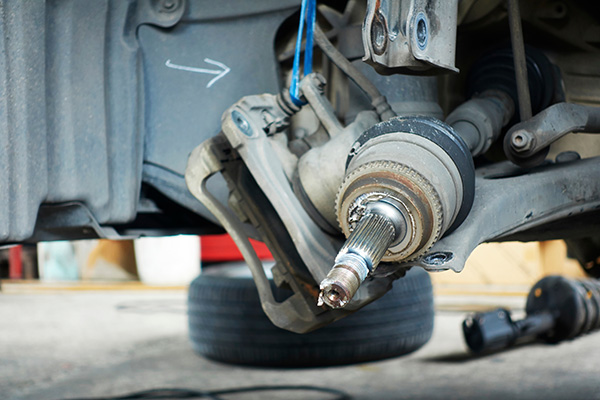
A CV joint can start going bad in a way that messes with your confidence more than your schedule. The car still moves, but a new sound shows up on the turns. Or you feel a shudder that was never there before, right when you’re trying to accelerate normally.
If you can figure out whether the inner or outer CV joint is the problem, you’re already closer to the right repair. The symptoms are different enough that you can often tell which side is failing just by noticing when it acts up.
Why CV Joints Fail In Real Life
CV joints, short for constant velocity joints, let the axle deliver power while the suspension moves up and down and the wheels steer left and right. Each axle typically has an outer joint near the wheel and an inner joint closer to the transmission.
The most common reason they fail is boot damage. The rubber boot holds grease in and keeps grit and water out. Once a boot tears, grease flings out and contamination works its way in. The joint can wear quickly after that, especially if the car sees rain, dirt roads, or lots of stop-and-go driving.
Outer CV Joint Symptoms You Can Hear In Turns
Outer CV joint failure usually makes itself known when the wheel is turned. The classic sign is a clicking, snapping, or rhythmic popping noise during tight turns, often most noticeable in parking lots or slow U-turns.
It tends to get louder when you add light throttle while turning because the joint is under load. Early on, you might only hear it at full steering lock. As wear progresses, it can start happening on normal turns too. We see this most often when a boot has been torn long enough that the joint has run dry and gritty.
Another clue is where it feels like it’s coming from. An outer joint issue often sounds and feels like it’s near one front corner of the car, especially with the window down.
Inner CV Joint Symptoms That Show Up Under Acceleration
Inner CV joints usually complain more when the vehicle is pulling straight and putting torque through the axle. Instead of clicking in turns, you’re more likely to feel a vibration or shudder during acceleration.
This is often described as a shake through the seat or floor that gets worse when you give it gas, then calms down when you lift off the throttle. It can be more noticeable going uphill, merging onto the highway, or accelerating from a stop.
An inner joint can also cause a clunk when shifting from Reverse to Drive, or during takeoff, because the joint has enough play to move suddenly when load direction changes. Not every clunk is an inner joint, but when it pairs with acceleration shudder, it belongs on the short list.
A Quick Pattern Guide To Narrow It Down
If you pay attention to when the symptom happens, you can usually tell which joint is more likely.
- Noise mainly during turns at low speed: outer CV joint is more likely.
- Vibration mainly during straight-line acceleration: inner CV joint is more likely.
- Louder with throttle while turning: outer joint wear tends to show up.
- Shudder that fades when you coast: inner joint wear tends to show up.
- Grease splatter near the inside of a wheel: a torn boot is likely, and the outer joint is often the first to get noisy.
These patterns are not perfect, but they’re good enough to keep you from chasing the wrong repair.
Problems That Can Mimic CV Joint Trouble
A few common issues can feel similar, especially if you’re only catching the symptom occasionally.
Wheel bearings can create a growl that rises with speed and may change slightly when you turn and load one side. Brake hardware can scrape if a backing plate is bent or a caliper is sticking. That can sound like grinding and change with wheel speed.
Tires can also fool you. Uneven wear can create a rhythmic hum or vibration that feels drivetrain-related, particularly at highway speed. Engine or transmission mounts can create a thump or shudder under acceleration because the drivetrain shifts more than it should.
If a warning pops up on the dashboard for traction control or stability control at the same time, it does not automatically mean the axle is the cause. It does mean the car is seeing unusual wheel behavior, so it’s worth checking soon.
When Driving Goes From Annoying To Risky
A mildly worn CV joint can sometimes be driven for a short time, but it will only get worse. If the noise or vibration is getting noticeably worse from week to week, you are past the wait-and-see stage.
Stop driving and schedule service promptly if you get loud clunking during acceleration, strong vibration that makes the car feel unstable, or a sudden jump in noise volume. A CV joint can fail completely, which can leave you stranded without warning.
If you see heavy grease flung around the wheel area, treat that as a sign the boot has opened up and the joint is likely on borrowed time.
Get CV Joint And Axle Service in Virginia with Chahel Automotive
We can inspect the CV boots and joints, pinpoint whether the inner or outer joint is failing, and confirm the real source of the noise or vibration before parts get replaced. Our technicians will also check related items that can mimic CV joint issues, like wheel bearings, mounts, and brake drag, so you get a clear answer the first time.
Call Chahel Automotive in Virginia to schedule an inspection and keep a small driveline problem from turning into a breakdown.